



The Development History Of Steel Structures
Jan 02, 2026
Leave a message
Although China achieved early successes in iron structures, it remained at the level of iron-based buildings for a long time. It wasn't until the end of the 19th century that my country began to adopt modern steel structures. After the founding of New China, the application of steel structures developed significantly, far surpassing previous levels in both quantity and quality. Light steel structure floors consist of cold-formed thin-walled steel frames or composite beams, OSB structural panels, supports, and connectors. The materials used include oriented strand board (OSB), cement fiberboard, and plywood. These lightweight floors can withstand a load of 316 to 365 kilograms per square meter.
The prevalence of steel structure buildings is an indicator of a country's or region's economic strength and level of economic development. After 2000, my country's national economy grew significantly, and its national strength increased markedly. China became a major steel producer in the world, and the concept of "actively and rationally using steel" in construction was introduced, shedding the constraints of "limiting steel use." Steel structure buildings gradually increased in economically developed regions. Especially around 2008, driven by the Olympic Games, a boom in steel structure construction occurred. Strong market demand propelled the rapid development of steel structure buildings, resulting in the construction of a large number of steel structure stadiums, airports, railway stations, and high-rise buildings. Some of these steel structures, such as the Olympic National Stadium, possess world-class manufacturing and installation technology.
After the Olympics, steel structure construction became widespread and continued to develop. Steel structures are widely used in buildings, railways, bridges, and residential construction. There are tens of thousands of steel structure enterprises of various sizes, and world-class steel structure processing equipment is readily available, such as multi-head multi-axis drilling machines, multi-axis pipe intersection cutting machines, and corrugated plate automatic welding machines. Hundreds of steel structure enterprises have world-class processing and manufacturing capabilities, such as those with Grade A and Grade B steel structure manufacturing qualifications. Steel production exceeds 600 million tons annually, and the variety of steel products fully meets construction needs. Steel structure design specifications, steel structure material standards, steel structure engineering construction quality acceptance specifications, and various professional standards and enterprise work methods are basically complete.
The downstream industries of the steel structure industry have a significant pulling and driving effect on its development; changes in their demand directly determine the future development of the industry.
1. The upstream industry of steel structures is the raw material supply industry, such as the steel industry.
The steel industry is the material foundation for the development of the steel structure industry. Technological advancements in the steel industry have created favorable conditions for the application of steel structures. Some large domestic steel companies have begun research and development of steel varieties and technologies for building structures, successively developing high-strength steel and steel resistant to fire, weathering, seawater, lamellar tearing, and low temperatures, as well as H-beams, high-performance color-coated steel plates, and cold-formed steel, laying a good application foundation for the development of the steel structure industry.
2. Impact of upstream and downstream industries on this industry
The upstream industry of steel structures is mainly the steel industry. Fluctuations in steel product prices directly affect the procurement costs of this industry. Overall, the upstream industry is basically a competitive industry, producing various steel plates, steel pipes, and structural steel used in steel structures. Among them, H-beams and medium-thick plates are the most commonly used products in steel structure buildings. Industry insight research data shows that in 2011, crude steel production reached 696 million tons, and production was relatively saturated, ensuring a stable supply of raw materials required for steel structure production.
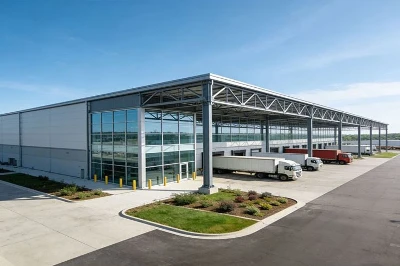
The downstream industries have a significant pulling and driving effect on the development of the steel structure industry. Changes in their demand directly determine the future development of the industry. With its comprehensive advantages such as high strength, light weight, good seismic performance, high degree of industrialization, short construction period, strong plasticity, energy saving and environmental protection, steel structures have been widely used in industrial plants, municipal infrastructure construction, cultural and educational sports construction, power, bridges, offshore oil engineering, aerospace and other industries, and the market space is gradually expanding. In addition, once the residential steel structure market makes a breakthrough and gradually replaces traditional building forms in the residential construction field, the steel structure industry will experience explosive growth.
Applications
Roofing System
It consists of roof trusses, structural OSB panels, waterproof layers, lightweight roofing tiles (metal or asphalt tiles) and related connectors. The roofing of Maiter's light steel structure buildings can have a variety of appearances. There are also various materials. While ensuring waterproofing technology, there are many options for appearance.
Wall Structure
The wall structure of light steel structure houses mainly consists of wall frame columns, wall top beams, wall bottom beams, wall supports, wall panels and connectors. In light steel frame residential buildings, the interior transverse walls typically serve as load-bearing walls. The wall columns are made of C-shaped light steel components, with wall thickness determined by the applied load, usually ranging from 0.84 to 2 millimeters. The spacing between wall columns is generally 400 to 600 millimeters. This wall structure arrangement in light steel frame residential buildings effectively and reliably supports and transmits vertical loads, and is easy to construct.
Send Inquiry