



Preparatory Work Before Steel Structure Installation And Welding
Jan 03, 2026
Leave a message
The tested steel materials included Q345GJC-Z15 (wall thickness 70mm), Q345GJC-Z15 (wall thickness 40mm), and Q345C (flange thickness 28mm). Welding positions included column-to-column horizontal welding, column-to-beam flat welding (including flat welding of the upper and lower flanges of the truss beam), and T-joint fillet welding. The groove form and dimensions were in accordance with design requirements. After passing visual and ultrasonic inspections, samples were taken for mechanical and physical testing.
The test results showed that the tensile strength of the joints reached the standard value of the base metal's tensile strength, and the joints showed no cracks after bending 180°. The welding materials and equipment used complied with national standards and had excellent performance. Slag removal, gouging, and electrode drying and insulation devices were complete and effective.
Manual Arc Welding and CO2 Gas Shielded Welding Materials and Equipment
(1) Electrodes should be dried in a high-temperature drying oven. The number of times electrodes are dried should not exceed two.
(2) Welding wire packaging should be intact. If damaged, resulting in contamination, bending, or entanglement of the welding wire, the affected portion should be discarded.
(3) The purity of CO2 gas should be no less than 99.9% (by volume), and the water content should be less than 0.05% (by weight). Use should be stopped when the high pressure in the cylinder is below 1 MPa.
(4) The welding machine voltage should be normal, the ground wire should be tightly fastened and reliably connected, the cables and welding tongs should be undamaged, the wire feeder should feed wire evenly, and the gas pipe should be free of leaks or blockages.
Installation Welding Procedure and General Regulations
The general welding sequence is: Pre-weld inspection → Preheating and rust removal → Installation of backing plates and arc striking plates → Welding → Inspection
1. Before welding, inspect the groove angle, root face, gap, and misalignment. Rust, oil stains, and mill scale on the groove and within 100mm on both sides should be thoroughly cleaned.
2. Preheating. Before welding, the base metal within 100mm of the groove and on both sides should be uniformly heated using gas welding or a special torch, and the temperature should be measured with a surface thermometer to prevent the temperature from failing to meet requirements or causing localized surface oxidation. Preheating temperature...
3. Recheck the preheating temperature; if the temperature is insufficient, reheat to meet the requirements.
4. Install the backing plates and arc striking plates. The surface cleanliness requirements are the same as those for the groove surface. The backing plates should be tightly fitted to the base metal, and the arc striking plates should be securely welded to the base metal.
5. Welding: The first weld pass should seal the connection between the base metal and the backing plate inside the groove. Then, weld layer by layer until the groove is filled. After each weld pass, slag and spatter must be removed. Welding defects should be ground off and repaired promptly.
6. Each joint must be welded continuously. If welding must be stopped midway, insulation and slow cooling treatment should be performed. Before resuming welding, reheat according to the regulations.
7. Welding should be stopped during rain or snow. Windbreaks and rain shelters should be provided around and above the component weld joints. Welding should be stopped when the wind speed exceeds 5 m/s. When the ambient temperature is below zero degrees Celsius, preheating and post-heating measures should be taken according to regulations.
8. For carbon structural steel, weld flaw detection should be performed after the weld cools to ambient temperature; for low-alloy structural steel, it should be performed 24 hours after completion.
9. Welders and inspectors must carefully fill out the work record sheet.
Welding Sequence and Process Parameters for Typical Joints
(1) For the upper and lower columns without ear plates, two welders weld symmetrically on both sides until 1/3 of the plate thickness is reached, then cut off the ear plates.
(2) Then, two welders weld symmetrically on both sides of the cut-off ear plate side until 1/3 of the plate thickness is reached.
(3) Then, two welders each undertake the welding of two adjacent sides.
(4) The joints of the weld passes between every two layers should be staggered. The weld joints of the two welders should also be staggered in each layer. The interpass temperature should be monitored during the welding process. (5) Welding Process Parameters:
CO2 shielded arc welding: welding wire diameter Φ1.2mm, current 280–320A, welding speed 350–450mm/min
Welding wire extension length: approximately 20mm, gas flow rate 25–80L/min,
Voltage 29–34V, interpass temperature 120–150℃
Column-Beam and Beam-Beam Joints
(1) Weld the lower flange of the beam first, ensuring symmetrical welding of the flange welds on both sides of the beam web.
(2) After the lower flange is welded, then weld the upper flange.
(3) If the flange plate thickness is greater than 30mm, it is advisable to alternate welding between the upper and lower flanges.
(4) Welding Process Parameters:
CO2 shielded arc welding: welding wire diameter φ1.2mm, current 280–360A, welding speed 300–500mm/min
Welding wire extension length approximately 20 mm, gas flow rate 20–80L/min
Voltage 30–38V, interpass temperature 120–150℃
Manufacturing
The processing and manufacturing of equipment steel structures are similar to those of precision steel structures, falling between ordinary structural components (with low processing requirements) and precision machining (requiring finer processing), using welding or bolted connections.
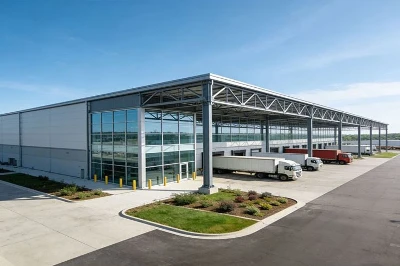
At the same time, the main types of steel structures include: frame structures for factory buildings, frame structures for multi-story buildings, frame-shear wall structures, frame-tube structures, flat grid structures and curved roof grid structures for large spaces, etc. Different building functions require different structural forms. Steel structure design must comply with national technical specifications, ensuring advanced technology, economic rationality, safety and practicality, and quality assurance. Therefore, the following requirements should be noted during structural design and manufacturing:
1. First, select an appropriate and reasonable structural system based on the building's functional requirements. Ensure advanced technology, novel structure, and the unity of architecture and structure.
2. Steel structures (except for containers) are mostly composed of members, so the dimensions of the members should be standardized and modularized as much as possible to facilitate mechanized manufacturing, transportation, and installation, and to improve productivity.
3. Use high-efficiency steel with high economic indicators. 4. The joints in steel structures are crucial; appropriate connection methods must be used to ensure that the joint design is consistent with the simplified model used in structural calculations. Historically, most structural failures have occurred at the joints, so careful design and construction of the joints are essential, utilizing advanced and reliable connection methods.
Send Inquiry